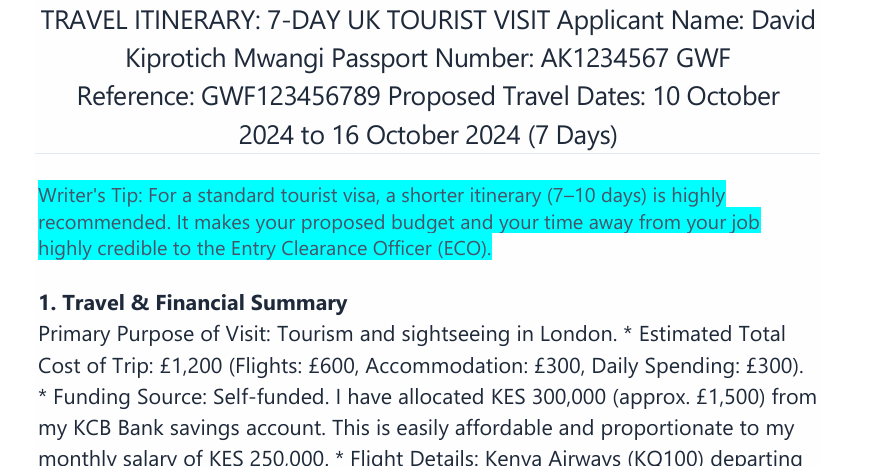
Securing entry clearance as a Standard Visitor requires a clear alignment between your proposed activities and declared financial circumstances. A well-constructed travel itinerary is the primary evidence demonstrating this geographical and economic logic to the Home Office. Entry Clearance Officers (ECOs) scrutinise the correlation between your daily plans and available funds to determine if your intentions are genuine.
Core Requirements for the UK Standard Visitor Visa
Applicants must satisfy the genuine visitor test outlined in Immigration Rules Appendix V. The burden of proof falls entirely on the individual to show a clear intention to leave the UK at the end of the visit. The core documentary requirements involve demonstrating:
- Sufficient personal funds to cover all reasonable costs of the visit without needing to work or access public funds.
- A clear intent to leave the UK before the six-month visa validity expires.
- Strong economic and social ties to your country of residence, often proven through employment contracts, property ownership, or family commitments.
The Standard Visitor Visa Application Process
The procedure begins on the central GOV.UK portal, where you complete the online form and pay the application fee. After submitting the form, you must book an appointment at a designated Visa Application Centre (VAC) to provide your biometric data (fingerprints and photograph).
All supporting documents must be uploaded digitally before the VAC appointment. Presenting physical paperwork at the centre can lead to additional administrative charges and slow down the processing of your application.
UK Standard Visitor Visa Application Fees
Application fees are determined by the requested visa validity period. The Home Office updates these costs periodically, and the correct payment must be made during the online submission. The current fee structure is as follows:
| Visa Validity Period | Current Home Office Fee (GBP) | Maximum Stay Per Visit |
|---|---|---|
| Standard (up to 6 months) | £115 | 6 Months |
| Long-term (2 years) | £400 | 6 Months |
| Long-term (5 years) | £771 | 6 Months |
| Long-term (10 years) | £963 | 6 Months |
UK Visitor Visa Processing Times
Standard processing aims for a decision within a set number of working days from your biometric enrolment date. Expedited services are available for applicants who need faster clearance, although their availability depends on the application location.
| Processing Service Tier | Estimated Decision Time | Additional Cost (GBP) |
|---|---|---|
| Standard Processing | 15 Working Days | £0 (Included in base fee) |
| Priority Visa Service | 5 Working Days | £500 |
| Super Priority Visa Service | Next Working Day | £1,000 |
Preparing for a UK Visitor Visa Interview
Standard Visitor applications do not usually require a formal interview unless an ECO finds significant discrepancies in the paperwork. If an interview is requested, questions will focus on financial anomalies, unclear employment histories, or the logic of the proposed trip.
You must be prepared to articulate exact cost breakdowns that align with your submitted bank statements. Contradictions between your verbal answers and the written application can lead to a refusal based on deception.
How to Improve Your UK Visitor Visa Success Rate
A successful application depends on sound geographical and financial logic. The total budget you declare must realistically cover your flights, accommodation, and the daily activities listed in your travel outline.
Unrealistic spending projections are a primary reason for visitor visa refusals. Submitting six months of consistent banking history that shows regular income and savings, without any large, unexplained deposits, helps establish financial credibility.
UK Visitor Visa Duration and Entry Rules
A Standard Visitor visa typically grants multiple entries over a six-month period. However, Border Force officers at the port of entry have the final authority and can cancel a visa if they suspect a material change in your circumstances since it was issued.
You must not appear to be living in the UK through frequent or successive visits. Spending more time in the UK than in your home country over a 12-month period will attract scrutiny on subsequent entry attempts.
A Sample 7-Day UK Tourist Itinerary for a Modest Budget
This itinerary demonstrates the required geographical and financial logic for an applicant with a declared budget of £500-£700 for a one-week stay in London. Activities are grouped geographically to minimise Transport for London (TfL) costs, keeping daily spending aligned with the available funds.
Including expensive activities like West End shows or luxury dining while showing low available capital will likely result in a refusal. This plan focuses on free, state-funded museums and logical walking routes to prove financial proportionality to the reviewing officer.
| Day | Geographical Focus | Planned Activities (Budget-Aligned) | Estimated Daily Cost (£) |
|---|---|---|---|
| Day 1 | Arrival & Base Logistics | Heathrow arrival, Elizabeth Line to Zone 2 accommodation, local supermarket grocery run. | £25 (Transport/Food) |
| Day 2 | Central London (Bloomsbury) | British Museum (Free Entry), walking tour of Covent Garden, pre-booked budget dinner. | £35 |
| Day 3 | South Bank Corridor | Tate Modern (Free Entry), walk across Millennium Bridge, external view of St Paul's Cathedral. | £30 |
| Day 4 | South Kensington | Natural History Museum (Free Entry), Hyde Park walking route, budget pub lunch. | £35 |
| Day 5 | Greenwich | Thames Clipper transport, Royal Observatory grounds (Free external), Greenwich Market. | £45 |
| Day 6 | Camden Town | Camden Market exploration, Regent's Canal walk to King's Cross. | £40 |
| Day 7 | Departure | Morning packing, Elizabeth Line to Heathrow Airport, flight check-in. | £15 (Transport) |
Permitted Activities on a UK Standard Visitor Visa
The Standard Visitor route consolidated several previous visa categories into a single framework. This means permitted activities now extend beyond tourism to include specific business, academic, and private medical purposes. It is important to state your primary purpose of visit correctly on the application form.
UK Visitor Visa Rules for Family Visits
Applicants visiting relatives in the UK must provide a formal sponsorship declaration and proof of their host's UK immigration status. ECOs may also assess the sponsor's accommodation size using documents like council tax bills to ensure the stay complies with UK overcrowding legislation.
If a host is providing financial support, they must submit their own bank statements and payslips. The combined disposable income of the applicant and sponsor must logically cover the entire visit without causing financial strain.
UK Visitor Visa Guidelines for Business Travel
Corporate visitors must adhere to strict limitations on permissible activities. Approved commercial operations include attending meetings, negotiating contracts, and undertaking specific site visits. You cannot undertake direct paid work or sell goods to the public.
The UK-based company or your employer must provide a detailed letter outlining the precise nature, duration, and financial backing of the business visit.
Logistical Planning for Your UK Itinerary
A logical sequence of travel arrangements helps establish you as a genuine and well-researched visitor. ECOs evaluate the practical feasibility of your proposed travel routes and accommodation locations relative to your stated budget. Each part of your plan should be defensible and realistic.
Booking Accommodation for Your Visa Application
Securing fully refundable hotel reservations provides a physical address for the application form without risking your capital before visa approval. The price and standard of the hotel must correlate directly with your stated socio-economic background and declared savings.
Budgeting for UK Public Transport
London's public transport network requires specific budgeting within your application. The TfL daily and weekly capping system limits expenses, providing predictable and verifiable data points for your daily budget calculation. For intercity travel, pre-booked tickets from National Rail demonstrate financial prudence, as expensive on-the-day fares contradict a low-budget travel plan.
Planning UK Attractions on a Budget
London has numerous state-funded museums and galleries that require no entry fee, which strongly supports lower-budget visa applications. You should list these specific free venues on your form rather than using vague terms like "general sightseeing." Paid attractions, such as the Tower of London, require clear financial allocation in your daily budget breakdown.
Managing Food Costs in Your Itinerary
Food expenditure is a significant part of the daily budget calculation. Modest applications should account for supermarket meal deals, self-catering, and fast-casual dining rather than high-end restaurants. An unrealistic food budget, such as allocating only £10 per day, may alert the ECO to a poorly planned application.
The Role of Travel Insurance in UK Visits
The Home Office does not require medical insurance for entry clearance. However, non-residents are charged 150% of the standard National Health Service (NHS) tariff for any medical care they receive. An unpaid NHS debt of over £500 will trigger a mandatory refusal for all future UK visa applications. Comprehensive travel insurance mitigates this serious immigration risk.
Including a Contingency Fund in Your Budget
A contingency reserve demonstrates sound financial planning to the entry clearance officer. Applicants should hold an unallocated buffer of at least £100 to £200 within their stated available funds to show they can cover unexpected costs or emergencies.
Professional Support for Your Visitor Visa Application
Regulated immigration professionals can help ensure compliance with Appendix V visitor requirements. A professional service audits financial documentation against the proposed itinerary to identify and rectify mathematical or logical inconsistencies that could lead to a refusal.
A professionally drafted cover letter provides the ECO with a concise summary of the applicant's intentions. This can help clarify complex banking histories or untraditional employment structures, reducing the risk of misinterpretation.
Final Considerations for a Successful Application
Approaching the entry clearance process as an exercise in financial and geographical logic is the most effective method for securing visa approval. Your daily itinerary dictates the required funds, and your bank statements must comfortably support that specific schedule.
Applicants who fail to synchronise their daily activity costs with their declared disposable income are likely to face rejection under the genuine visitor rules. Strict adherence to financial proportionality is the foundation of a credible application.