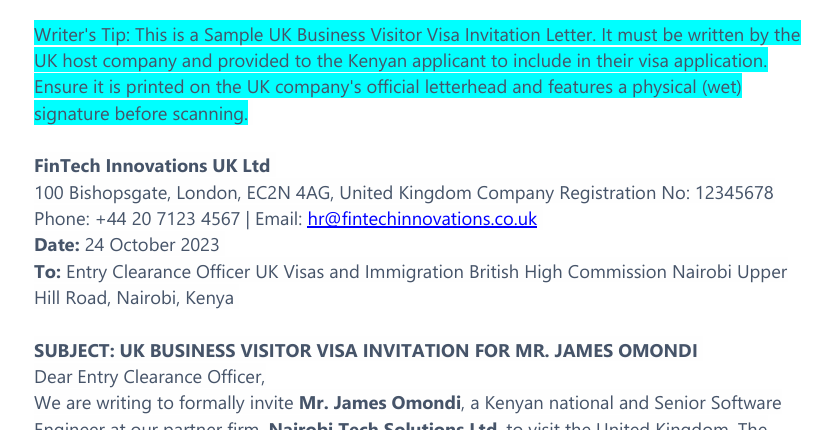
Submitting a successful Standard Visitor application requires demonstrating clear, permissible corporate objectives within the United Kingdom. A professionally drafted invitation letter for a UK business visa acts as the primary document confirming the applicant's stated intentions. Entry Clearance Officers (ECOs) depend on this documentation to assess compliance with stringent immigration rules.
Purpose of the UK Business Visitor Visa Invitation Letter
The Home Office demands explicit proof that a visitor will not enter the UK labour market. The formal invitation establishes the exact parameters and limitations of the corporate visit. ECOs scrutinise this correspondence to differentiate permissible activities, such as attending meetings or negotiating contracts, from prohibited productive work.
Structuring the UK Business Visa Invitation Letter Format
Formal immigration correspondence follows a strict structural hierarchy. The inviting organisation must print the letter on official corporate letterhead that contains registered company credentials. A structured, predictable format helps the evaluating ECO to process the information and assess the application efficiently.
Mandatory Information for a UK Business Invitation Letter
Every invitation must specify the applicant's biographical data, travel itinerary, and financial sponsorship details. Omissions in these categories often lead to application refusals under Appendix V of the Immigration Rules. Sponsoring companies must supply precise operational data to support the visit.
| Information Category | Required Details for UKVI Compliance |
|---|---|
| Visitor Profile | Full legal name, passport number, nationality, and current job title. |
| Visit Parameters | Exact entry and exit dates, specific meeting locations, and daily schedules. |
| Financial Allocation | Clear declaration of who covers flights, accommodation, and daily subsistence. |
Specific Content for Company-Issued UK Business Invitations
Corporate invitations must meticulously describe the proposed activities to eliminate ambiguity. Proving non-productive activity represents a high hurdle for many applicants, such as a Kenyan entrepreneur invited to a UK conference or corporate summit. The letter must explicitly state the visitor is "attending scoping meetings with potential suppliers" rather than "working on a project."
Applying this precise phrasing prevents the ECO from suspecting that the applicant will engage in paid, productive work. Clarifying that the individual remains strictly an observer or negotiator satisfies the Home Office restrictions on foreign labour.
Drafting a UK Business Invitation Letter for a Company Director
Directors attending board meetings or negotiating commercial contracts require specific, elevated wording. The correspondence must reference their executive capacity and the strategic commercial necessity of their physical presence in the UK. Providing corporate registration documents alongside the letter strengthens the application.
Drafting an Invitation for an Employee Attending Training
Seconded employees or staff attending internal corporate training require letters detailing their substantive role in their home country. The issuing company must confirm the employee remains on the foreign payroll and receives no remuneration from a UK source. The document should outline the specific training modules or software platforms the employee will observe.
Host Company Guidelines for UK Business Invitation Letters
UK-based host entities bear the responsibility of justifying the commercial need for the invitation. The host must clearly define the existing or proposed commercial relationship with the overseas applicant. Stating the expected corporate outcome of the visit reinforces the legitimacy of the application.
Supporting Documents for a UK Business Visa Application
The formal invitation cannot stand alone in the submission bundle. Applicants must submit corroborating evidence to validate the corporate claims made within the sponsor's correspondence. Discrepancies between the letter and supporting files can result in immediate visa rejections.
Key Document Requirements for a UK Business Visa
ECOs expect a portfolio of financial and employment documentation to prove ties to the applicant's home nation.
- Current passport with a minimum of six months validity.
- Certified bank statements covering the preceding six months.
- Formal employment contract or certificate of business incorporation.
- Tax compliance certificates from the applicant's country of residence.
Accessing a Sample UK Business Visa Invitation Letter PDF
Reviewing a legally compliant template provides applicants with a baseline for drafting their own submissions. Professional PDF templates align with current UK Visas and Immigration (UKVI) enforcement guidelines. Adapting a verified template helps ensure the inclusion of all mandatory statutory declarations.
Avoiding Common Pitfalls in UK Business Invitation Letters
Vague terminology is a primary reason for business visa refusals. Using verbs like "consulting," "assisting," or "managing" implies illegal productive activity within the UK. Sponsoring companies must exclusively use permissible action verbs such as "observing," "attending," or "negotiating."
Legal Implications of Sponsoring a UK Business Visitor
UK organisations signing these letters accept institutional accountability for the foreign visitor's conduct. False representations in immigration documents violate the Immigration Act 1971. Sponsoring entities risk severe penalties, including the suspension of their own corporate sponsor licences, if a visitor breaches their entry conditions.
Next Steps for a Compliant Invitation Letter
Securing entry clearance requires careful navigation of complex immigration frameworks. Professional legal drafting aligns corporate intentions with strict Home Office parameters. Seeking professional assistance ensures that your correspondence withstands bureaucratic scrutiny.
Editor's Final Recommendation
Drafting compliant corporate immigration correspondence demands precision and a thorough command of permissible activities under UK law. Sponsoring organisations must prioritise exact, non-productive language to secure timely approvals. Instructing qualified professionals to audit your documentation is an effective strategy to mitigate the risk of costly visa refusals.