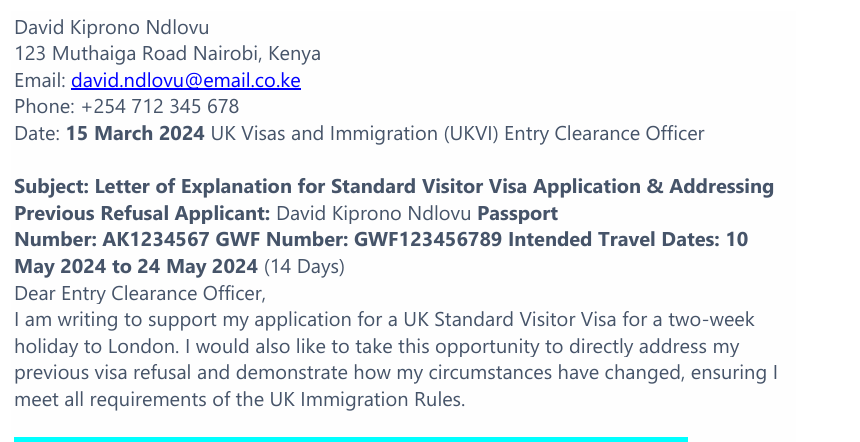
Navigating UK immigration law requires strict adherence to evidential thresholds and precise procedural protocols. A detailed cover letter for a visa application dictates the narrative of a reapplication, directly addressing prior discrepancies and presenting new substantive evidence to the Entry Clearance Officer (ECO).
How to Write an Effective Letter of Explanation for a UK Visa Refusal
An effective explanation letter adopts an objective, legalistic tone that isolates the exact grounds of the prior refusal. Applicants must abandon emotional appeals and focus exclusively on evidential remedies. The document serves as a roadmap for the ECO to locate and verify the newly submitted materials quickly.
Precision dictates the structure of this document. The letter must state the previous Global Web Form (GWF) reference number, explicitly cite the immigration rules used for the refusal, and systematically list the new documents provided to satisfy those rules.
Understanding Sample Letters of Explanation for UK Visa Refusals
Sample letters provide a structural framework for formatting an official response, but applicants cannot rely on verbatim templates. Every visa refusal stems from unique financial or personal circumstances that require highly specific evidential mapping. A successful reapplication relies on adapting the structural principles of these samples to present an individualised factual matrix.
Analysing successful samples reveals a consistent pattern of strict cross-referencing. Strong letters index each new piece of evidence to a specific concern raised in the prior refusal notice.
Key Elements in a Letter of Explanation for a Previous UK Visa Refusal
A compliant document requires several non-negotiable elements. Missing any of these components reduces the efficacy of the reapplication.
- Applicant Identifiers: Full legal name, passport number, date of birth, and the previous refusal GWF number.
- Direct Acknowledgement: A factual statement recognising the previous decision date and specific refusal paragraphs (e.g., Appendix V).
- Indexed Explanations: Numbered paragraphs addressing each point raised by the ECO.
- Documentary Index: A clear, bulleted list of the exact supplementary documents attached to the new application.
Structuring Your UK Visa Refusal Explanation Letter with a Sample
Overcoming a refusal under paragraph V4.2, which frequently concerns "Funds Parking" or unexplained large deposits, demands precise wording. The applicant must respectfully acknowledge the ECO's legitimate concerns regarding financial provenance before introducing the new evidence.
Below is a realistic structural sample of a successful response to a V4.2 refusal:
"Dear Entry Clearance Officer, I respectfully acknowledge the previous decision dated 12 May 2023 (Ref: GWF123456789), which refused my application under paragraph V4.2. The Entry Clearance Officer accurately observed an unexplained sudden deposit of £5,000 on 01 April 2023. To rectify this evidential omission, please find enclosed a Sacco loan disbursement schedule (Appendix A). This schedule, alongside the formal loan agreement (Appendix B) and corresponding pay slips showing Sacco deductions (Appendix C), verifies that the £5,000 constitutes a legitimate personal loan for my travel expenses, rather than parked funds."
Crafting an Effective Cover Letter for a UK Visa Reapplication
A well-written cover letter for a visa application bridges the gap between past omissions and current compliance. The author must explicitly state how the new application differs from the previous submission. Resubmitting the exact same portfolio of documents guarantees a consecutive refusal.
The letter should lead the reviewing officer directly to the corrective evidence. Use bold text to highlight document references, ensuring the ECO spends minimal time searching for the facts that clear the previous doubts.
Guidance for Complex UK Visa Refusals
Complex refusals often involve multiple overlapping concerns, such as questionable ties to the home country combined with unclear employment histories. Addressing these requires a multi-tiered explanatory letter. The applicant must separate each issue under distinct subheadings to maintain structural clarity.
For instance, an applicant facing refusal on both financial and familial grounds must dedicate separate sections to employment verification and dependency proofs. Merging these explanations creates narrative confusion and increases the risk of a secondary refusal.
Common UK Visa Refusal Reasons and How to Address Them
Entry Clearance Officers apply strict scrutiny against the Immigration Rules, leading to frequent rejections based on predictable evidential failures. Addressing these requires targeted documentation rather than general assurances.
Identifying Specific Grounds for a Previous UK Visa Refusal
Understanding the exact legal codes cited in the refusal notice determines the required corrective action. The refusal letter details these codes systematically.
| Refusal Code | Common Descriptor | Required Evidential Remedy |
|---|---|---|
| Paragraph V4.2(a) | Intent to Leave / Genuine Visitor | Property deeds, permanent employment contracts, family ties. |
| Paragraph V4.2(e) | Funds Provenance (Funds Parking) | Loan disbursement schedules, asset sale receipts, tax returns. |
| Paragraph V4.3 | Maintenance and Accommodation | Sponsorship declarations, confirmed hotel bookings, bank statements. |
Learning from Past UK Visa Application Mistakes
Applicants frequently err by assuming the ECO has contextual knowledge of their home country's banking systems or employment practices. UK Visas and Immigration (UKVI) evaluates applications strictly on the physical evidence provided. Translating local financial practices into universally understood, documented formats eliminates ambiguity.
Essential Supporting Documents for a UK Visa Reapplication
The explanation letter holds no weight without the physical documentation to back up its claims. Every assertion made in the letter requires a corresponding, verifiable document.
Compiling New Evidence and Supplementary Materials for a UK Visa
New evidence must definitively resolve the doubts established in the prior decision. If the ECO doubted an applicant's income stability, the reapplication requires tax clearance certificates and certified bank statements spanning six months.
Third-party financial support requires exhaustive proof. Sponsors must provide their own bank statements, proof of legal residence in the UK, and a legally binding declaration of support.
Ensuring Compliance with UK Visa Application Guidelines
UKVI enforces strict formatting regulations for all supplementary materials. Applicants must submit original documents or certified copies, accompanied by verifiable translations for any material not written in English or Welsh.
Professional translators must provide their credentials, contact details, and a signed declaration verifying the accuracy of the translation. Failure to adhere to these translation guidelines automatically renders the evidence inadmissible.
Navigating the UK Visa Reapplication Process
Reapplying requires methodical preparation and adherence to strict operational procedures. Rushing a subsequent application without securing the necessary corrective documents compromises the entire process.
Step-by-Step Guide to UK Visa Resubmission
Executing a compliant resubmission involves a linear progression of tasks to ensure total accuracy.
- Analyse the Refusal: Extract every individual objection raised by the ECO in the initial refusal notice.
- Procure Evidence: Obtain official, stamped documents that directly counteract each identified objection.
- Draft the Explanation: Write the formal cover letter indexing the new materials.
- Submit and Pay: Complete the new online form, pay the requisite fees, and secure a biometric appointment.
Understanding Timelines for UK Visa Application Decisions
Reapplications enter the standard processing queue unless the applicant purchases priority services. Prior refusals can occasionally trigger more extensive background checks, slightly extending processing durations.
| Visa Category | Standard Processing Time | Priority Processing Time |
|---|---|---|
| Standard Visitor Visa | 3 Weeks | 5 Working Days |
| Skilled Worker Visa | 3 Weeks | 5 Working Days |
| Student Visa | 3 Weeks | 5 Working Days |
Key Elements of a UK Visa Refusal Explanation Template
A good template enforces discipline on the applicant's writing. It prevents the inclusion of irrelevant personal narratives that distract the reviewing officer from the core financial and legal facts.
Structuring Your UK Visa Explanation Letter
A logical hierarchy accelerates the review process. The letter must open with definitive applicant details, transition into the formal acknowledgement of the refusal, present the indexed rebuttals, and conclude with a formal sign-off.
Using clear, bolded headings for each section allows the ECO to scan the document efficiently. Dense blocks of text hinder comprehension and slow down the assessment.
Avoiding Pitfalls in Your UK Visa Application Response
Never adopt an adversarial or accusatory tone towards the Entry Clearance Officer. Challenging the ECO's competence or complaining about the refusal outcome damages the application's credibility.
Additionally, avoid overwhelming the application with irrelevant paperwork. Submitting primary school certificates or unstructured photo albums does not resolve concerns regarding financial solvency or intent to return.
UK Visa Types Commonly Affected by Previous Refusals
Standard Visitor Visas generate the highest volume of refusals due to the subjective nature of the "genuine intent to return" assessment. Applicants for these visas must construct the most detailed explanatory letters, as the burden of proof relies heavily on demonstrating ties to the home country.
Student Visas and Skilled Worker Visas operate on a points-based system, making their refusals more technical. Reapplications in these categories require specific corrections, such as providing an updated Confirmation of Acceptance for Studies (CAS) or a newly issued Certificate of Sponsorship (CoS).
When to Seek Professional Reapplication Assistance
Complex immigration histories benefit from professional legal review. Regulated immigration advisers have the analytical training to identify subtle deficiencies in an application that a layperson might overlook.
Engaging professional assistance ensures the explanation letter aligns with current UKVI caseworking guidance and prevailing immigration law.
Practitioner's Recommendation
Treat the reapplication not as an appeal, but as a completely new factual proposition. By deploying a heavily indexed explanation letter that politely acknowledges the ECO's previous findings while introducing undeniable, verified new evidence—such as formal loan disbursement schedules to explain sudden deposits—applicants increase their probability of securing entry clearance.