Success in the UK immigration system depends on preparing clear supporting evidence to establish an applicant's financial stability and intent to return. A well-structured cover letter for a UK visa application provides a guide for the Entry Clearance Officer, explaining complex self-employment documentation. Applicants must prove they operate a legitimate business and have strong economic ties to their home country.
The Role of a Cover Letter for Self-Employed UK Visa Applicants
UK Visas and Immigration (UKVI) closely examines applications from self-employed individuals because of the variable nature of their income. A specific cover letter helps explain the connection between financial data and the applicant's actual circumstances. A logical structure allows the Entry Clearance Officer to understand the applicant's professional standing and financial position quickly.
Defining Your Business Operations in the Cover Letter
A clear definition of your business operations prevents misinterpretation by UKVI. The cover letter should state the legal structure of your business, the specific goods or services you provide, and your ownership percentage. Vague descriptions can lead to a visa refusal based on unverified financial circumstances.
Meeting UKVI Financial Requirements for the Self-Employed
Meeting the financial requirements involves more than showing a large bank balance. Applicants must prove the origin of their funds and show that the business generates consistent revenue. Submitting official tax documents substantiates active trading and removes doubts about the legitimacy of the business.
| Document Category | Primary Purpose for UKVI | Required Evidence Example |
|---|---|---|
| Tax Compliance | Shows active trading and legal compliance | KRA Tax Compliance Certificate (or national equivalent) |
| Banking Records | Demonstrates cash flow and genuine income | 6 months of verified business and personal statements |
| Accounting | Verifies profitability and business stability | Audited Financial Statements signed by an accountant |
Key Supporting Documents for Self-Employed Applicants
Assembling the correct evidence requires matching each document to the claims made in your cover letter. Missing mandatory documents often causes automatic application rejections.
- Valid Passport with at least one blank page for the visa vignette.
- Certificate of Incorporation or official Business Registration Certificate.
- Recent Tax Returns and a current Tax Clearance Certificate.
- Official Business Bank Statements covering the previous six months.
- Contracts, invoices, or purchase orders showing active client work.
Stating the Purpose of Your Visit and Itinerary
Entry Clearance Officers check the stated purpose of the visit against the requested visa category. The letter must detail specific activities, such as attending a business conference in London or visiting family in Manchester. Ambiguity about the itinerary can raise doubts about an applicant's intentions.
How to Address Your UK Visa Cover Letter
Addressing the correct authority sets a professional tone. Direct the letter to the "Entry Clearance Officer" at "UK Visas and Immigration". Do not use informal greetings or name specific individuals, as applications are processed at large, centralised centres.
Structuring a Cover Letter for a Self-Employed Application
Drafting the letter requires organising information into clear sections. This structure allows the adjudicator to cross-reference your statements with the provided documents. The following sections outline the necessary components for a self-employed applicant's cover letter.
Introduction and Applicant Details
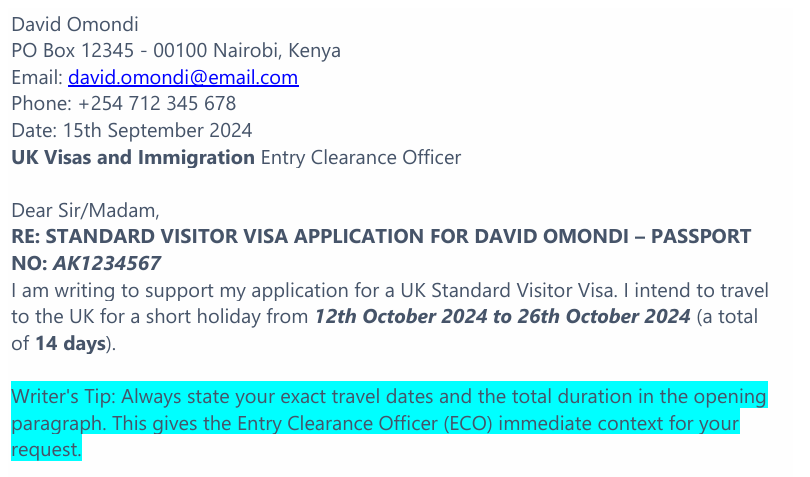
The first paragraph must state your full legal name, passport number, and the specific visa you are applying for. Including your Global Web Form (GWF) number links your documents directly to your online application. This precision helps speed up the initial processing at the Visa Application Centre.
Demonstrating Business Continuity and Financial Ties
Showing business continuity is a critical factor for self-employed applicants. Your letter must include a dedicated section explaining who will manage the business while you are in the UK. Naming a specific deputy, partner, or senior manager proves the business can function without your physical presence.
A certificate of incorporation alone is not enough to meet UKVI standards. Applicants must supply tax documents, such as a KRA Tax Compliance Certificate, to prove strong economic ties to their country of residence. These documents confirm the business is actively trading and paying local taxes, reducing concerns that an applicant might overstay.
Detailing Your Itinerary and Accommodation
A clear itinerary removes guesswork for the reviewing officer. State your exact arrival and departure dates and intended flight details. Include confirmed accommodation details, with the full physical address and contact information for your hotel or host.
Conclusion and Document Index
The final section should summarise your commitment to follow UK immigration rules and return to your home country. Provide a numbered list of all attached supporting documents. This index serves as a checklist for the Entry Clearance Officer, ensuring no piece of evidence is overlooked.
Common Mistakes to Avoid in Your Cover Letter
Many applicants weaken their case by submitting excessive or irrelevant documents that obscure key information. Unexplained large deposits in business or personal bank accounts raise immediate questions under money laundering regulations. You should address any financial anomalies directly in the cover letter to prevent the officer from making negative assumptions.
Tips for Writing an Effective UK Visa Cover Letter
Using a formal, objective tone improves the application's credibility. Keep the letter to a maximum of two pages to hold the reader's attention on the most important evidence. Cross-referencing claims to specific document appendix numbers helps the adjudicator process the information efficiently.
Final Checklist Before Submission
Reviewing your application package systematically helps catch small administrative errors that can cause significant processing delays.
- Verify all names match your passport exactly, with no abbreviations.
- Ensure all financial documents cover the specific six-month period required by UKVI.
- Check that certified translations are included for any documents not in English or Welsh.
- Confirm your named business deputy has provided a signed letter accepting temporary responsibility.
- Validate that tax compliance certificates are current and have not expired.
When to Seek Professional Cover Letter Assistance
Complex business structures, such as those involving holding companies or variable dividends, may need professional interpretation to align with UKVI rules. Consulting an immigration professional can ensure your cover letter effectively presents your financial and economic ties to your home country.
Practitioner's Recommendation
Self-employed applicants should approach the cover letter as a formal submission, not an informal letter. Focus on providing evidence of active trading with official tax documents. Document your economic ties by explaining your business continuity plans. Providing clear, verifiable data is the most effective way to meet the requirements of UK Visas and Immigration.