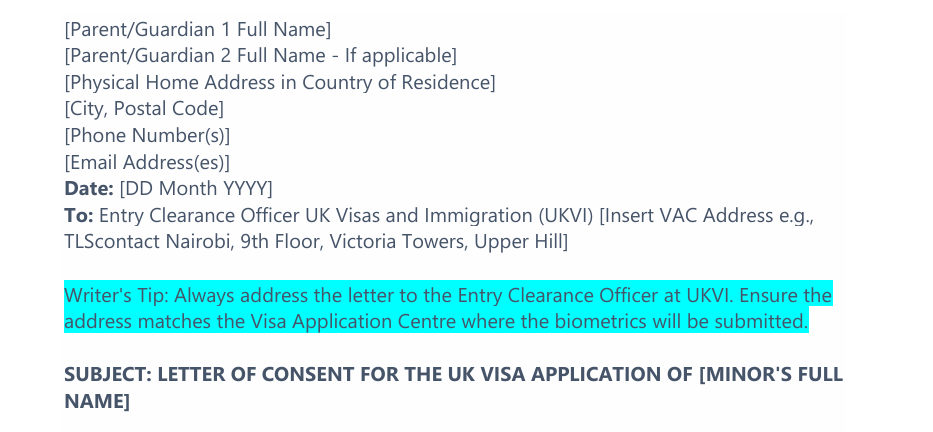
Securing entry clearance for children under 18 requires strict adherence to international safeguarding protocols and precise documentation. The UK visa application form mandates specific supporting evidence, including a formal consent document, to satisfy border officials regarding the child's welfare and travel arrangements.
Drafting a UK Travel Consent Letter for a Minor
Formulating a clear consent document helps prevent border delays and potential entry refusals. UK Visas and Immigration (UKVI) officials scrutinise these letters to confirm parental authorisation for the specified dates of travel. UK child safeguarding rules require the letter to include explicit consent from all non-travelling parents or legal guardians.
Immigration regulations state that informal, unverified letters hold no evidentiary weight. Parents must treat this document as a binding declaration that establishes the legitimacy of the child's travel.
The UK Visa Application Process for Minors
Applications for children have different requirements compared to adult submissions. The standard online portal captures basic biometrics and travel dates, but the supporting documents determine the final entry clearance decision. Parents must upload the consent letter alongside the primary application dossier before booking the biometric appointment.
Caseworkers assess the financial maintenance and accommodation arrangements provided by the adults involved. Incomplete documentation automatically triggers refusal under Appendix V of the Immigration Rules.
Consent Letter Specifics for a Child Travelling with One Parent
Single-parent travel prompts additional checks at UK border control points. The absent parent holds legal rights that the immigration officer must verify before granting the child entry. Accompanying adults must carry a signed declaration from the non-travelling parent confirming their awareness and approval of the trip.
Applicants must attach certified copies of the non-travelling parent's passport bio-data page to confirm the signature on the consent letter. Failure to provide matching identification renders the consent document invalid.
Key Information for a UK Minor Travel Consent Letter
A travel consent document requires specific fields to satisfy immigration caseworkers. Using a standardised format ensures rapid processing by border officials. The document must capture the exact address and contact details of the UK receiving adult and be formatted with a designated space for notarisation.
- Full legal names, dates of birth, and passport details of the minor.
- Full legal names and passport details of all parents or legal guardians.
- Explicit written consent from all non-travelling parents or legal guardians.
- The exact residential address and a contact telephone number for the UK receiving adult.
- A designated execution block for a Notary Public or Commissioner of Oaths stamp and signature.
UK Travel Requirements for Unaccompanied Minors
Unaccompanied children face a high level of immigration security checks. The receiving adult in the UK assumes immediate legal responsibility for the child's care, accommodation, and eventual departure. Caseworkers evaluate the suitability of the UK caregiver and their relationship to the child before issuing a visa.
Strict age parameters dictate how border officials process unaccompanied minors upon arrival. The table below outlines the regulatory requirements based on the applicant's age group.
| Age Category | Border Force Processing Requirement | Required Accompanying Documentation |
|---|---|---|
| Under 5 Years | Not permitted to travel unaccompanied. | N/A (Must travel with an adult). |
| 5 to 15 Years | Mandatory airline escort service to the border. | Notarised consent, receiving adult ID, airline handover forms. |
| 16 to 17 Years | Independent border presentation permitted. | Notarised consent, proof of UK accommodation, proof of independent travel capability. |
UK Visa Requirements for Minors Travelling from Kenya
Kenyan nationals have specific documentary requirements when processing minor applications through the regional Visa Application Centre (VAC) in Nairobi. Biometric enrolment is mandatory for all applicants, including infants. Birth certificates issued by the Kenyan civil registry serve as the primary proof of relationship between the child and parents.
Affidavits sworn before a Kenyan High Court advocate are often submitted to support the main consent letter. Consular staff require original documents alongside clear photocopies for the final application file.
Handling Consent Letters in Complex Family Situations
Complex family structures demand additional legal documentation to establish sole custody or guardianship. Sole legal guardians must submit court orders or a death certificate to proceed without dual parental consent. UK immigration rules do not accept informal separation agreements as proof of sole responsibility.
Only state-issued court decrees or official adoption papers satisfy the burden of proof for single-party consent. Applicants must supply certified translated copies of these documents if the originals are in a language other than English or Welsh.
The Legal Basis for UK Parental Consent Rules
The Home Office operates under Section 55 of the Borders, Citizenship and Immigration Act 2009. This legislation places a statutory duty on immigration officers to safeguard and promote the welfare of children. Border Force officials have the authority to detain minors if they suspect parental consent regulations have not been met.
Officers routinely cross-reference the details on the physical consent letter with the data submitted in the electronic visa application. Discrepancies between the stated UK caregiver and the approved visa sponsor can result in the child being detained pending further investigation.
Navigating UK Border Control Procedures for Minors
Presentation at the UK border is the final stage of the entry clearance process. Electronic passport (ePassport) gates restrict access for children under 10, which means they require an in-person inspection by a Border Force officer. Families must join the correct queue to present their physical documentation.
Officers will interview the accompanying adult and may ask the minor simple questions to verify the purpose of the trip. Maintaining an organised physical file of all supporting documents, including the original consent letter, accelerates this mandatory inspection.
Consular and Embassy Document Standards
British High Commissions and Embassies enforce rigid standards for translated documents and certified copies. Consular staff will reject documents that lack official translation certification or are missing the contact details of the translator. Strict adherence to the published guidelines ensures a smoother review process.
Original documents are still necessary for the physical border crossing, even after digital submission. Applicants must carry the original notarised consent letter with them for the entire duration of the trip.
Ensuring Compliance with UK Child Travel Regulations
Meeting the statutory requirements for minor travel often requires professional legal oversight. UK Visa Assist Kenya provides application management and document auditing to ensure full compliance with Home Office regulations. Our practitioners verify consent forms against current safeguarding guidance to confirm they meet all requirements.
This level of preparation helps ensure your documentation withstands caseworker scrutiny and prevents border delays. Proper legal review of the application file reduces the risk of entry refusal and helps secure the child's entry clearance.
Final Checklist for the Consent Letter
Formulating a complete and accurate consent letter prevents serious legal and logistical problems at the UK border. Applicants must prioritise notarisation and precise caregiver details to align with statutory safeguarding duties. Treat the travel consent document with the same gravity as the passport itself.