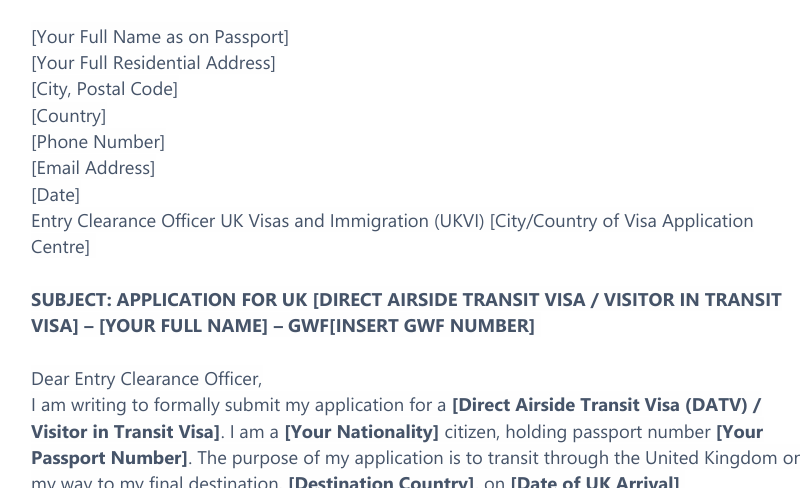
Passengers navigating international aviation routes often require specific transit clearances when passing through intermediate countries. For the UK, a well-structured UK visa covering letter is a legal document that explains your routing and validates your onward travel credentials to UK Visas and Immigration (UKVI). Drafting this document requires absolute factual precision to prevent any suggestion of long-term immigration intent.
How to Structure a UK Transit Visa Cover Letter
Your application requires a highly structured approach that prioritises logistical facts over personal narrative. UKVI Entry Clearance Officers assess applications against strict immigration rules, so applicants must demonstrate clear, immediate plans to leave the United Kingdom. Your correspondence must establish an indisputable timeline from your arrival at the UK border to your departure.
Essential Components of a UK Transit Visa Cover Letter
UKVI may refuse transit applications if the proposed flight path lacks geographical logic. Your letter must include a "Logical Route" justification, proving why a layover in the UK is a viable operational choice. For instance, a passenger travelling from Nairobi to Toronto should explain the absence of direct flights and the efficiency of the connection via London Heathrow (LHR).
Include the following structured sections in your draft:
- Applicant Details: Full legal name, passport number, and contact information, ensuring they match your official documents.
- The "Logical Route" Justification: Explicit reasoning for transiting through the UK, such as it being the shortest total flight time from your origin to your final destination.
- Onward Travel Authorisation: Details of your visa or permit for the destination country, for example: [Insert Valid US/Canadian Visa Number], [Insert Expiry Date], [Insert Issuing Authority].
- Flight Itinerary: Provide the arrival flight number, departure flight number, and the exact layover duration calculated in hours.
Supporting Documents Required for Your UK Transit Visa Application
Documentary evidence must directly corroborate every claim made in your correspondence. Unsubstantiated claims about your routing can trigger an application refusal under current UK immigration protocols.
Applicants must compile the following mandatory documentation:
- A valid passport containing at least one blank page for the entry vignette.
- Confirmed flight tickets showing the entire journey from the country of origin to the final destination.
- A valid entry visa, electronic travel authorisation, or residence permit for your destination country.
- Proof of legal residence in the country from which you are applying.
Clearly Stating Your Purpose of Transit in the UK Cover Letter
Entry Clearance Officers require an unambiguous declaration of your transit purpose. The text must state that you possess neither the intention nor the means to remain in the United Kingdom. Emphasise that your presence in the UK is solely a logistical necessity to facilitate your international journey.
Addressing Your UK Visa Covering Letter Correctly
Correct legal formatting helps establish credibility with the assessing authority. Direct your correspondence to the Entry Clearance Officer at the specific UKVI processing hub that manages your region.
Use a formal business letter layout, placing the UKVI address at the top left, followed by the date and your personal details. Open with "Dear Entry Clearance Officer," and close with "Yours faithfully" if applying independently.
Key Considerations for a Successful Transit Application
Precision and brevity determine the outcome of immigration correspondence. Remove subjective adjectives and focus entirely on dates, flight numbers, and visa categories.
Applicants must ensure their transit window complies with the limits of their requested visa tier. Direct Airside Transit Visas (DATV) restrict layovers to 24 hours without passing through UK border control, while Visitor in Transit visas permit a maximum 48-hour stay, which includes crossing the border.
When to Seek Professional Assistance for Your Cover Letter
Complex itineraries or previous visa refusals can increase the risk associated with a new application. Consulting an Office of the Immigration Services Commissioner (OISC) registered advisor ensures your documentation meets current legal standards. An OISC registered advisor can identify structural weaknesses in your routing logic before submission, mitigating the risk of a refusal.
Understanding the UK Transit Visa Application Process
Securing transit clearance is managed through a digitised, multi-stage legal framework. UKVI requires applicants to complete detailed online declarations before attending an appointment for physical document verification.
Online Submission and Biometric Appointments
The process starts on the official Gov.uk portal, where applicants must complete the specific transit visa questionnaire. After paying the fee online, the system redirects you to book a mandatory appointment at a local Visa Application Centre (VAC), which is typically managed by a commercial partner like VFS Global or TLScontact.
During the VAC appointment, officials will capture your biometric data, including digital fingerprints and a compliant facial photograph. You will also submit your physical passport and printed supporting evidence, which will be dispatched to a UKVI decision-making centre.
UK Transit Visa Processing Times and Fees
Processing times depend on the visa category selected and standard UKVI service targets. Delays can occur during peak global travel seasons. All fees and processing times are subject to change by UKVI.
| Transit Visa Category | Standard Processing Time | Application Fee (Approx.) | Layover Limit & Rules |
|---|---|---|---|
| Direct Airside Transit Visa (DATV) | 3 Weeks | £35 | Max 24 Hours (No border crossing) |
| Visitor in Transit Visa | 3 Weeks | £64 | Max 48 Hours (Allows border crossing) |
Final Recommendations for Your Transit Visa Letter
Outsourcing your documentation to specialists can help ensure strict adherence to UKVI routing mandates. Professional drafters work within the necessary legal frameworks, making sure your onward visa credentials and flight logic present a clear case for transit clearance.
To minimise refusal risks, applicants must treat the transit justification as a rigorous legal defence of their travel itinerary. Do not assume UKVI will independently verify the efficiency of your route. You must explicitly detail your geographical constraints and onward authorisations to secure a positive decision.