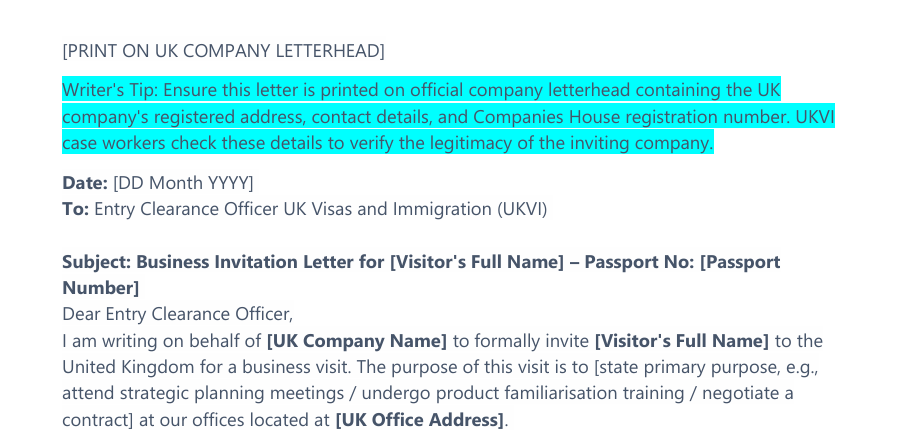
Formal corporate immigration documents must adhere strictly to UK Visas and Immigration (UKVI) guidelines. Using a compliant template for invitation letter uk business visa reduces the risk of application refusal by clearly defining the purpose and parameters of the corporate visit.
The Purpose of a UK Business Visitor Visa Invitation Letter
The invitation letter is a formal declaration from a UK-based organisation that substantiates an applicant's stated reason for entering the country. Entry Clearance Officers use this document to verify that the proposed activities are permitted under the Standard Visitor route. An ambiguous or poorly drafted letter can lead to administrative delays or an outright visa refusal.
Who Can Authorise a Business Visa Invitation Letter
A senior representative of the UK host company, such as an executive, HR Director, or a designated compliance officer, must author and sign the letter. The signatory assumes professional responsibility for the accuracy of the information provided to the Home Office. Sole traders or smaller, unregistered entities may face higher scrutiny and should be prepared to supply additional business registration evidence.
Key Information for a Business Visitor Invitation Letter
UKVI caseworkers scrutinise applications for any indication that a business visitor may attempt to undertake paid or unpaid work. The invitation letter must explicitly list the permitted activities as outlined in Appendix Visitor of the Immigration Rules. Examples include "attending board meetings," "negotiating agreements," or "signing corporate contracts." The document must also state that the visitor will not receive payment from a UK source or perform work for clients during their stay.
Structuring Your UK Business Visitor Invitation Letter
A standard corporate format helps the Entry Clearance Officer find information efficiently. The document should be on official company letterhead and organised with clear headings and numbered paragraphs. In immigration correspondence, factual precision is more important than stylistic prose.
Opening Paragraph Requirements
The first paragraph must establish the UK company's details, including its Companies House registration number. It should then state the applicant's full name as it appears on their passport, along with their date of birth and nationality. Ensuring this data matches the applicant's passport exactly prevents initial identity-related queries.
Detailing the Purpose and Itinerary of the Visit
Provide a detailed, day-by-day schedule of the applicant's proposed activities. Vague descriptions like "business discussions" are a significant red flag for UKVI and may raise suspicions of an intention to work. Specify the dates, locations, and individuals involved in each scheduled corporate meeting or event.
Closing Statements and Sponsor Responsibilities
The closing section must clarify who holds the financial liability for the trip. State whether the UK host company or the applicant's overseas employer will cover the cost of flights, accommodation, and living expenses. The signatory must also provide a direct corporate telephone number and email address to allow for any UKVI verification checks.
A Step-by-Step Guide to Drafting the Letter
Creating a compliant document requires a systematic approach to data collection and formatting. A rushed process often leads to errors such as conflicting dates or omitted passport details, which can jeopardise the application.
Step 1 Pre-Drafting Data Collection
Before writing, obtain a high-resolution scan of the applicant's current passport data page. Cross-reference the proposed travel dates with the UK company's internal meeting schedules and any relevant corporate event logs to ensure consistency.
Step 2 Drafting the Main Body
Use clear, declarative sentences to outline the visitor's planned activities. It is good practice to reiterate the "No Permitted Work" clause within this central section to address any UKVI concerns about illegal employment directly.
Step 3 Final Review and Signature
The final draft should be reviewed by legal counsel or an internal compliance team to check its alignment with current UK Immigration Rules. The authorised signatory must apply a wet-ink or verified digital signature before the document is sent.
Common Pitfalls in Business Invitation Letters
Ambiguity about the applicant's remuneration is a leading cause of application failure. If the letter does not explicitly deny payment from a UK source, caseworkers may assume that prohibited work will occur. Any discrepancy between the dates on the invitation letter and the submitted flight itinerary will likely result in an automatic refusal.
Submitting the Invitation Letter with the Application
Send the finalised letter to the applicant in a non-editable PDF format via a secure digital channel. The applicant must then upload this exact file to the commercial partner portal (VFS Global or TLScontact) when they submit their online visa application form.
Supporting Documentation for a Business Visitor Application
Both the UK host and the applicant must provide evidence to support the invitation letter and visa application. Missing or inconsistent documents from either party can weaken the application's credibility.
Documents from the UK Host Company
The UK-based company must supply valid corporate documentation to prove its legal and operational status. UKVI actively cross-references this data with public records to confirm authenticity.
| Document Type | Validity / Age Requirement | Immigration Purpose |
|---|---|---|
| Companies House Registration | Active status verified online | Proves legal corporate existence in the UK |
| Corporate Bank Statements | Issued within the last 90 days | Demonstrates the host's financial viability |
| Signatory Identification | Valid passport copy | Verifies the host's legal status and authority |
Documents from the Applicant
The applicant must demonstrate strong economic and personal ties to their home country to meet the genuine visitor requirement. Evidence of stable overseas employment indicates that the applicant intends to leave the UK after their visit.
- Letter from overseas employer confirming ongoing employment and salary.
- Personal bank statements covering a six-month period to show proof of funds.
- Proof of property ownership or family commitments in the home country.
Tips for a Successful Application
Maintain absolute consistency across the online application form, the invitation letter, and all supporting evidence. If there is a conflict in information, such as the duration of the stay or the funding source, provide a written explanation. It is also wise to inform company receptionists and HR staff about the pending application in case UKVI makes verification calls.
Final Checks and Professional Guidance
Standard templates require careful customisation to fit specific corporate situations. Consulting a regulated immigration adviser ensures the invitation meets the precise evidentiary standards of the UK Immigration Rules. A professional review can help eliminate procedural errors that might otherwise trigger a costly refusal. If you need expert assistance, you can schedule a consultation to discuss your specific circumstances.