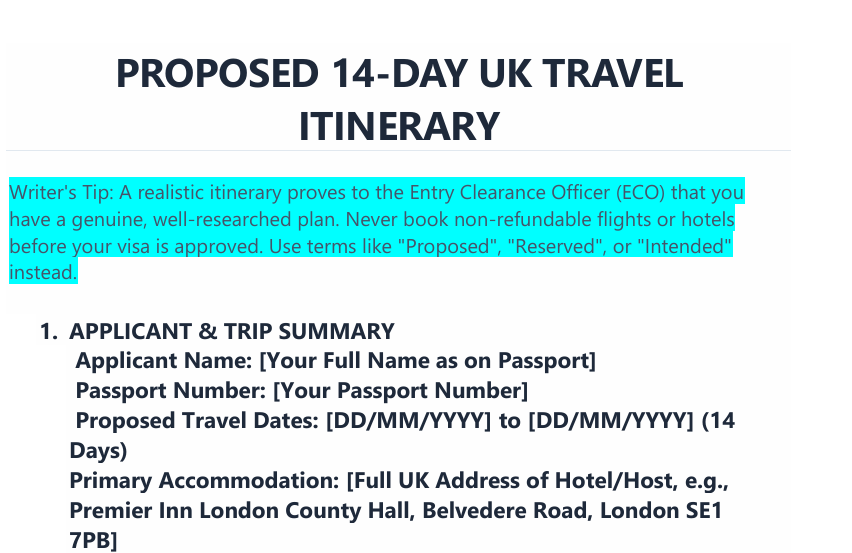
Executing a successful immigration submission requires precise alignment between declared intentions and supporting documentary evidence. A correctly structured sample UK visa itinerary serves as the primary framework for Entry Clearance Officers assessing the credibility of your proposed visit.
Understanding the UK Tourist Visa Application Process
The standard visitor route permits individuals to enter the UK for up to six months for tourism, business, or brief study. Applicants must complete the online application via the GOV.UK portal before scheduling biometric appointments at designated regional centres. Failure to comprehend these strict procedural steps frequently results in administrative refusals.
Core Documentation for a UK Tourist Visa Application
Consular staff rely entirely on written evidence to evaluate immigration risk. Providing a logically ordered dossier prevents delays in assessment and provides clear context for your intentions. Your submission package must be self-contained, as you will not have an opportunity to explain documents during the decision-making process. Each piece of evidence should support the statements made on your application form, creating a consistent and credible narrative for the Entry Clearance Officer.
- Completed online application form
- Valid passport and expired travel documents
- Proof of financial solvency
- Detailed travel itinerary
Passport and Travel History Requirements
Current passports must contain at least one blank page for the entry vignette and remain valid for the entire duration of the intended stay. Previous passports establish a verifiable travel history, demonstrating historical compliance with international immigration laws.
Proof of Accommodation and Flight Bookings
Entry Clearance Officers expect provisional arrangements rather than fully paid, non-refundable reservations. Submitting unconfirmed flight itineraries and flexible hotel bookings mitigates financial risk if the Home Office issues a refusal.
Invitation Letters and Sponsorship Documents
Host declarations must specify the relationship to the applicant and outline exact logistical provisions. Sponsors supplying accommodation must provide land registry documents or tenancy agreements alongside utility bills verifying occupancy limits.
Financial Requirements and Proof of Funds for UK Visa
Financial scrutiny forms the core of the adjudication procedure. Evaluators verify that applicants hold sufficient liquid assets to maintain themselves without accessing public funds or undertaking unauthorised employment.
Bank Statements and Income Verification
Applicants must present six months of consecutive, official bank statements showing regular salary deposits. Large, unexplained transfers immediately prior to submission can trigger credibility checks and subsequent refusals.
Sponsor Declarations and Financial Support Letters
Third-party financiers must legally commit to covering designated expenses throughout the duration of the visit. Sponsors must present tax returns, employment contracts, and corresponding banking histories to validate their financial capacity.
Key Considerations for Crafting a 14-Day UK Itinerary
A logically sequenced 14-day schedule establishes the genuine nature of the visit. Implausible geographical transitions may prompt caseworkers to question the validity and feasibility of the application.
Balancing Sightseeing and Travel Time
Applicants frequently underestimate transit durations between disparate UK regions. Factoring realistic travel windows between activities demonstrates thorough preparation and regional awareness.
Popular UK Regions for a Two-Week Holiday
A standard two-week schedule typically incorporates London, the Midlands, and a northern territory. Structuring the visit around distinct geographical zones simplifies transport logistics and justifies the requested duration of stay.
Sample 14-Day UK Travel Itinerary Breakdown
Providing a day-by-day account clarifies your geographical footprint. The schedule must align directly with booked accommodation dates and transit reservations.
Days 1-5 London Exploration and Iconic Landmarks
The initial phase concentrates on Greater London and its immediate environs. Activities typically include ticketed entry to state museums, parliament tours, and verified day trips to adjacent counties.
Days 6-10 Northern England and Cultural Sites
Mid-itinerary schedules transition via rail to northern hubs like Manchester or York. Documenting specific train routes and advanced ticket reservations strengthens the credibility of this transit phase.
Days 11-14 Scottish Highlands or Southern Coast Exploration
The final leg details the furthest geographical reach of the visit. Applicants must clearly indicate return transit arrangements connecting back to the principal departure airport to prove their intention to leave.
Accommodation and Transportation Planning for Your UK Trip
Logistical frameworks require strict alignment with proposed daily activities. Discrepancies between hotel locations and listed sightseeing venues can raise credibility flags.
Budget-Friendly Accommodation Options in the UK
Hostels, budget hotel chains, and short-term rentals present acceptable lodging solutions. The application must include full addresses, contact numbers, and lead-guest names for every proposed overnight stop.
Navigating Public Transport and Car Rentals Across the UK
Intercity rail passes or pre-booked coach services demonstrate a viable method for executing the proposed schedule. Car rental intentions require documentation of valid international driving permits and estimated fuel costs.
UK Visa Processing Times and Application Tips
Standard visitor clearance requires approximately three weeks from the biometric submission date. Peak summer intakes regularly push processing limits to six weeks, requiring proactive scheduling. Always check the official GOV.UK website for the most current processing time estimates for your specific location.
Demonstrating Strong Ties to Your Home Country
Establishing an undeniable incentive to return home mitigates the risk of overstaying. Permanent employment contracts, property deeds, and documented family dependencies form the strongest evidence of domestic ties.
The Role of Professional Support in Visa Applications
Generic templates can fail to capture the nuances of an applicant's background. A customised schedule that reflects personal interests and aligns with verified financial capacity helps to avoid rejections based on a non-credible or unfeasible plan.
UK Tourist Visa Application Fees and Associated Costs
Entry clearance carries strict, non-refundable administrative costs. Evaluators separate visa fees from the actual operational budget required to execute the proposed visit.
Standard Visitor Visa Fees Breakdown
The Home Office mandates standardised payments for entry clearance. Short-term applications incur fixed costs that scale based on multi-entry requirements over extended validity periods.
| Visa Type | Duration | Current Fee (GBP) |
|---|---|---|
| Standard Visitor | 6 Months | £115 |
| Long-Term Visitor | 2 Years | £400 |
| Long-Term Visitor | 5 Years | £771 |
Optional Priority Service Charges
Expedited processing accelerates a decision but does not guarantee an approval. Priority options require additional payments directly to commercial partners managing the Visa Application Centres.
| Service Tier | Target Processing Time | Additional Fee (GBP) |
|---|---|---|
| Priority Service | 5 Working Days | £500 |
| Super Priority | Next Working Day | £1,000 |
Estimated Daily Spending Budget in the UK
The Home Office heavily scrutinises financial projections against declared savings. Using a structured budget alignment table ensures your calculations withstand casework examination. Applicants must ensure the sum of the "Estimated Daily Cost" column exactly matches the total trip budget typed into the GOV.UK online form. Discrepancies between the online declaration and the physical itinerary schedule represent a leading cause of credibility refusals.
| Date | Activity Plan | Accommodation | Transport Method | Estimated Daily Cost (£) |
|---|---|---|---|---|
| Day 1 | [Arrival & Check-in] | [Hotel Name/Address] | [Airport Transfer] | [£ Amount] |
| Day 2 | [Specific Sightseeing] | [Hotel Name/Address] | [Local Tube/Bus] | [£ Amount] |
| Day 3 | [Specific Sightseeing] | [Hotel Name/Address] | [Local Tube/Bus] | [£ Amount] |
| Total | [Must Match GOV.UK Form] |
Travel Insurance Requirements for a UK Journey
The National Health Service (NHS) limits free provisions for overseas visitors to emergency, life-saving interventions. Securing comprehensive medical coverage prevents potential immigration sanctions linked to unpaid hospital debts.
Best Time to Apply for Your UK Tourist Visa
Regulations permit submissions up to three months prior to the intended date of travel. Early lodgement accommodates unexpected processing delays and allows sufficient time to resolve potential requests for additional documentation.
How Professional Assistance Supports Your Application
Navigating the Immigration Rules requires exact interpretation of procedural mandates. Professional oversight can help eliminate contradictory evidence and fortify the entire submission package.
Specific Support Services for UK Visa Applicants
Legal representatives audit financial records, cross-reference itineraries against Home Office guidelines, and draft formal covering letters. This structured approach directly addresses the specific risk factors associated with an applicant's demographic.
Arrange a Personalised UK Visa Consultation
Securing an expert evaluation before submission helps prevent costly administrative errors. Initiate a formal assessment to verify your documentary readiness and compliance with the Standard Visitor rules.
Final Practitioner's Recommendation
Success in UK Entry Clearance relies entirely on the mathematical and logistical alignment of your submission. Guarantee that your structured itinerary reflects realistic transit times, and ensure your daily cost breakdown precisely equals the total budget declared on your official GOV.UK application form.